
Website Privacy Notice
NEW SPRING VISTA CIC
WEBSITE PRIVACY NOTICE
How we collect, use, protect and share personal information
Purpose of this notice
This notice applies to people who visit our website, make an inquiry, book or take part in our services, refer a participant, or otherwise communicate with New Spring Vista CIC.
It should be read alongside our Cookie Notice, Terms and Conditions and relevant consent or participation forms.
1. Who we are
New Spring Vista CIC provides ground-based equine facilitated learning, nature-based wellbeing and personalised development programmes for children, young people and adults.
New Spring Vista CIC is the data controller for the personal information described in this notice. This means that we decide why and how that information is used.
Registered company name: New Spring Vista CIC
Company number: 16335807
Registered office: 45 Mendip Vale, Coleford, Radstock, England, BA3 5PP
Email: newspringvista@gmail.com
Telephone: 07540 886191
We have not appointed a statutory Data Protection Officer. Questions or requests about personal information should be directed to our Privacy Lead using the contact details above.
2. Who this notice covers
This notice may apply to:
-
participants and prospective participants, including children, young people and adults;
-
parents, carers, guardians and emergency contacts;
-
people making enquiries or subscribing to updates;
-
schools, local authorities, health or support professionals, grant-making bodies, funders and referring organisations;
-
suppliers, contractors, volunteers and other professional contacts; and
-
visitors to our website or premises.
Where a parent, carer or professional gives us information about another person, they should ensure that they are authorised to do so and, where appropriate, have made this notice available to that person.
3. Information we may collect
Depending on your relationship with us, we may collect and use:
-
identity information, including names, titles, dates of birth and age;
-
contact information, including postal address, email address and telephone numbers;
-
parent, carer, guardian and emergency-contact details;
-
booking, attendance, payment status, invoice and transaction information (payment providers normally process card or bank details directly);
-
enquiry, referral, assessment, consent and participation-form information;
-
communication preferences, support needs and reasonable adjustments;
-
session plans, observations, progress information, learning-journal records and reports;
-
correspondence, feedback, complaints and records of contact with us;
-
safeguarding, accident, incident, risk-assessment and insurance information;
-
photographs, audio, video, testimonials and case-study material where the appropriate permission has been obtained;
-
website and device information, such as IP address, browser type, pages visited and cookie preferences; and
Special category information
Some information requires additional protection under data-protection law. Where relevant to safety, suitability, reasonable adjustments or personalised support, this may include:
-
physical or mental health and medical information;
-
disability, SEND, neurodivergence, communication and wellbeing information; and
-
in limited circumstances, information revealing religious or philosophical beliefs, racial or ethnic origin, or sexual orientation where a person chooses to disclose it and it is relevant to their support or safeguarding.
We aim to collect only the information that is relevant and proportionate for the service, safety or legal purpose concerned.
4. How we obtain information
We may obtain personal information:
-
directly from you through our website, enquiry and booking forms, emails, telephone calls, meetings, assessments and sessions;
-
from a parent, carer, guardian or emergency contact;
-
from a school, local authority, healthcare or support professional, grant-making body, funder or other referring organisation;
-
from payment, website, booking, email and cloud-service providers;
-
from publicly available sources where appropriate; and
-
automatically through essential cookies and, where you consent, analytics or other non-essential technologies.
5. Why we use information and our lawful bases
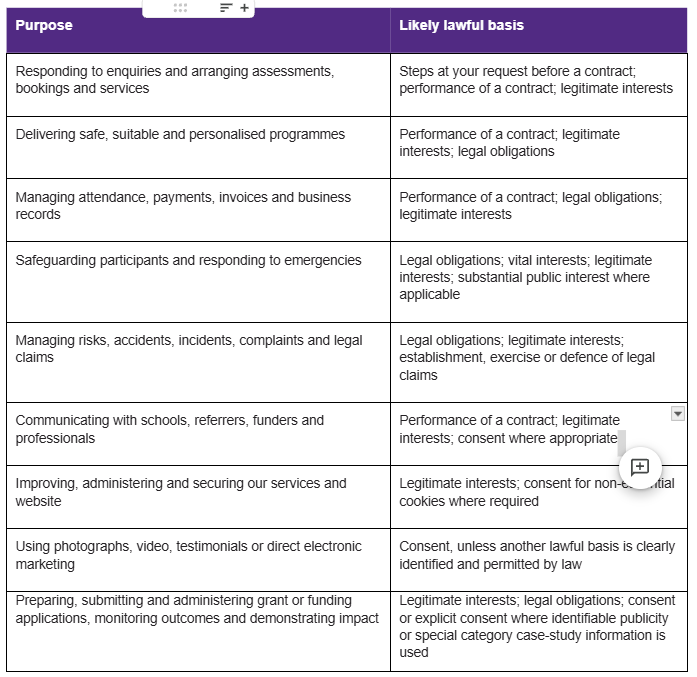
Data-protection law requires us to have a lawful basis for using personal information. More than one basis may apply to the same activity.
Special category information
When we use health, disability, SEND or other special category information, we also identify an additional legal condition. Depending on the circumstances, this may include explicit consent, protecting vital interests, safeguarding or another substantial-public-interest condition, or the establishment, exercise or defence of legal claims. We will not rely on consent where it would not be freely given or where another legal condition is more appropriate.
Our legitimate interests include operating and improving a safe and effective community-interest service, communicating with families and professional partners, protecting our participants, animals, staff and property, maintaining appropriate records and defending legal rights. We balance these interests against the rights and expectations of the people concerned.
6. Children and young people
We provide services to children and young people and therefore take particular care with their information. Information may be provided by, and communications may be conducted through, a parent, carer, guardian, school or referring professional. We explain information to the child or young person in an age-appropriate way where reasonably possible and take account of their views and developing capacity.
Parental or carer permission does not remove the child or young person's own data-protection rights. Where consent is the basis for processing, we consider who is able to provide valid consent in the circumstances.
7. If you do not provide information
Some information is needed to assess suitability, keep participants safe, administer bookings or meet legal and insurance obligations. If required information is not provided, we may be unable to offer or continue a service. Optional information, including promotional photography consent, is not a condition of receiving our core services.
8. Sharing information
We do not sell personal information. We disclose it only where this is necessary, proportionate and lawful. Recipients may include:
-
parents, carers, guardians and emergency contacts, where appropriate;
-
schools, local authorities, grant-making bodies, funders, commissioners, healthcare or support professionals and referring organisations involved in the participant's support or the funding, monitoring or evaluation of our work;
-
safeguarding partners, emergency services, regulators, courts or other public authorities where required or permitted by law;
-
our insurers, professional advisers, accountants and legal advisers;
-
carefully selected providers of website hosting, booking systems, communications, email, cloud storage, document management, design, social media, IT support and payment processing; and
-
contractors or authorised personnel who need the information to perform their duties and are subject to confidentiality and data-protection requirements.
We may share information without consent where this is required or permitted for safeguarding, emergency response, prevention or detection of crime, regulatory compliance, legal proceedings or another lawful purpose. Where consent is appropriate, we will seek it before sharing. For grant and impact reporting, we use anonymous statistics and anonymised case studies wherever reasonably possible and share identifiable participant information only where necessary and lawful.
Our principal technology and service providers may include Wix (website, forms and bookings), Google (email, Drive, Forms and Calendar), GoCardless (payment processing), Calendly while it remains in use, Meta services including Facebook, Instagram and Messenger, WhatsApp, and Canva where it is used to prepare identifiable content. These organisations may act as our processors or as independent controllers for particular activities. Their own privacy information may also apply.
9. International transfers
Some technology providers may store or process information outside the United Kingdom. Where this happens, we require an appropriate legal safeguard, such as UK adequacy regulations, the UK International Data Transfer Agreement or UK Addendum to approved standard contractual clauses, together with any additional measures required. Further information about relevant safeguards is available on request.
10. Keeping information secure
We use proportionate organisational and technical measures designed to protect personal information against accidental loss, unauthorised access, alteration or disclosure. These include:
-
locked storage for paper records;
-
password-protected devices and accounts, with additional authentication where available;
-
access restricted to people who need the information for their role;
-
secure disposal and deletion processes;
-
confidentiality, safeguarding and data-protection procedures; and
-
assessment and management of suspected personal-data breaches.
No method of transmission or storage is completely secure. If a breach is likely to create a risk to people's rights and freedoms, we will take appropriate action and notify the Information Commissioner's Office and affected individuals where the law requires.
11. How long we keep information
We keep information only for as long as reasonably necessary for the purpose for which it was collected, including safeguarding, insurance, tax, accounting and legal requirements. We consider the nature and sensitivity of the information, the risks of retaining it, applicable limitation periods and any instructions from relevant insurers or authorities.
Our usual retention approach is:
General enquiries that do not lead to a service: Normally up to 12 months after the last meaningful contact
Contracts, invoices and core financial records: Normally 7 years after the end of the relevant financial year or contractual relationship
Adult participant, assessment, attendance, progress, consent and incident records: Normally 7 years after the final service, unless a longer safeguarding, insurance or legal period applies
Ordinary child participant, assessment, attendance, progress and consent records: Normally 7 years after the final service or until the participant reaches age 21, whichever is later, unless a longer safeguarding, insurance, contractual or legal period applies
Child safeguarding and child-protection records: Normally retained until the child or young person reaches age 25, and longer where legal proceedings, a statutory inquiry, professional guidance or insurer requirements make this necessary
Concerns or allegations relating to workers or volunteers: Normally retained until the person reaches normal retirement age or for 10 years from the allegation, whichever is longer, subject to safeguarding, legal and insurer requirements
Complaints, claims, incidents and circumstances that may give rise to a claim: Normally 6 years after closure, but relevant documentation is retained for as long as proceedings or insurer requirements continue and is not destroyed while a claim or circumstance remains live
Photography, case-study and media permissions: For the period of permitted use, with a limited record of the permission and any withdrawal retained as necessary to demonstrate compliance
Website analytics and cookies: For the period stated in our Cookie Notice and the settings of the relevant service
These periods may be shortened or extended where justified. Information that is no longer required is securely deleted, anonymised or destroyed.
12. Photographs, video, testimonials and publicity
We separate participation in our services from permission for promotional photography, video, testimonials, case studies or publicity. Refusing promotional permission will not affect access to our core services or funding decisions. Permission choices may distinguish between internal use, grant applications, printed material, our website and named social-media channels. For children and young people, we seek permission from the appropriate parent or carer and, where appropriate, involve the child or young person and respect their wishes.
Where consent is used, it may be withdrawn at any time for future use by contacting us. We will stop new use and remove material under our control where reasonably possible. Withdrawal cannot always reverse publication already completed, remove printed materials already distributed, or control copies independently shared by other people or platforms. We avoid pairing a child's full name, precise location, support needs or other unnecessary identifying details with public images or stories. We may retain a limited record of the consent and its withdrawal to demonstrate compliance.
13. Website, cookies and analytics
Our website may use essential cookies or similar technologies needed for security and basic operation. Non-essential analytics, embedded-media, advertising or similar technologies will be used only where the required consent has been obtained. You should be able to accept or reject non-essential cookies and change your choices later through the website's cookie controls.
Our separate Cookie Notice explains the technologies used, their purposes, providers and retention periods. Information entered into website forms is used for the purpose stated on the form and handled in accordance with this notice.
14. Your data-protection rights
Depending on the circumstances and the lawful basis being used, you may have the right to:
-
be informed about how your personal information is used;
-
request access to your personal information and receive a copy;
-
ask us to correct inaccurate or incomplete information;
-
ask us to erase information where there is no lawful reason to keep it;
-
ask us to restrict how information is used;
-
object to processing based on legitimate interests and object at any time to direct marketing;
-
receive certain information in a portable format or ask for it to be transferred;
-
withdraw consent at any time where processing is based on consent, without affecting earlier lawful processing; and
-
complain to the Information Commissioner's Office.
These rights are not absolute and exemptions may apply. We may need to verify identity and clarify a request. We normally respond within one month, although the law permits an extension for complex or numerous requests. We do not normally charge a fee.
To exercise a right, contact us using the details in section 1. If a request concerns a child or another person, we may need to consider authority, capacity and the best interests and rights of the person concerned.
15. Automated decision-making
We do not use personal information to make decisions based solely on automated processing that produce legal or similarly significant effects. Suitability, support and safeguarding decisions involve human judgement.
16. Marketing communications
Where required, we send electronic marketing only with consent. Every marketing communication will provide a way to unsubscribe, and you may withdraw consent at any time. We may retain a minimal suppression record so that we can respect an opt-out.
17. Complaints
Please contact us first if you have a concern so that we have an opportunity to resolve it. You are not required to contact us before complaining to the Information Commissioner's Office (ICO).
Information Commissioner's Office
Wycliffe House
Water Lane
Wilmslow
Cheshire
SK9 5AF
Telephone: 0303 123 1113
Website: https://www.ico.org.uk
18. Changes to this notice
We may update this notice when our services, systems, providers or legal obligations change. The current version will be published on our website. Where a change materially affects how we use existing personal information, we will take reasonable steps to bring it to the attention of affected people.
Last updated: 25 August 2026
Next scheduled review: August 2027, or sooner if required